Moroccan Tea Ceremony
Ritual, Symbolism & Etiquette
Discover the subtle art and quiet codes of the Moroccan tea ceremony. Explore the ritual, symbolism, and gestures that make every pour an act of presence and grace.
Moroccan Tea Ceremony Ritual: What’s Served, When, and How
The Moroccan tea ceremony is a flowing experience that unfolds gradually. It begins with preparation—a quiet prelude that demands patience and skill. Green tea (often Chinese gunpowder tea) forms the base, joined by large sprigs of fresh mint and generous spoonfuls of sugar. The pot is placed on the stove, left to boil, and then comes the critical first pour.
This first pour is not meant for drinking. Instead, it is a cleansing gesture: a small amount of tea is poured out into a glass, then returned to the pot, helping to blend the flavors. Sometimes, the host discards the first infusion entirely, replacing it with fresh water for a cleaner taste.
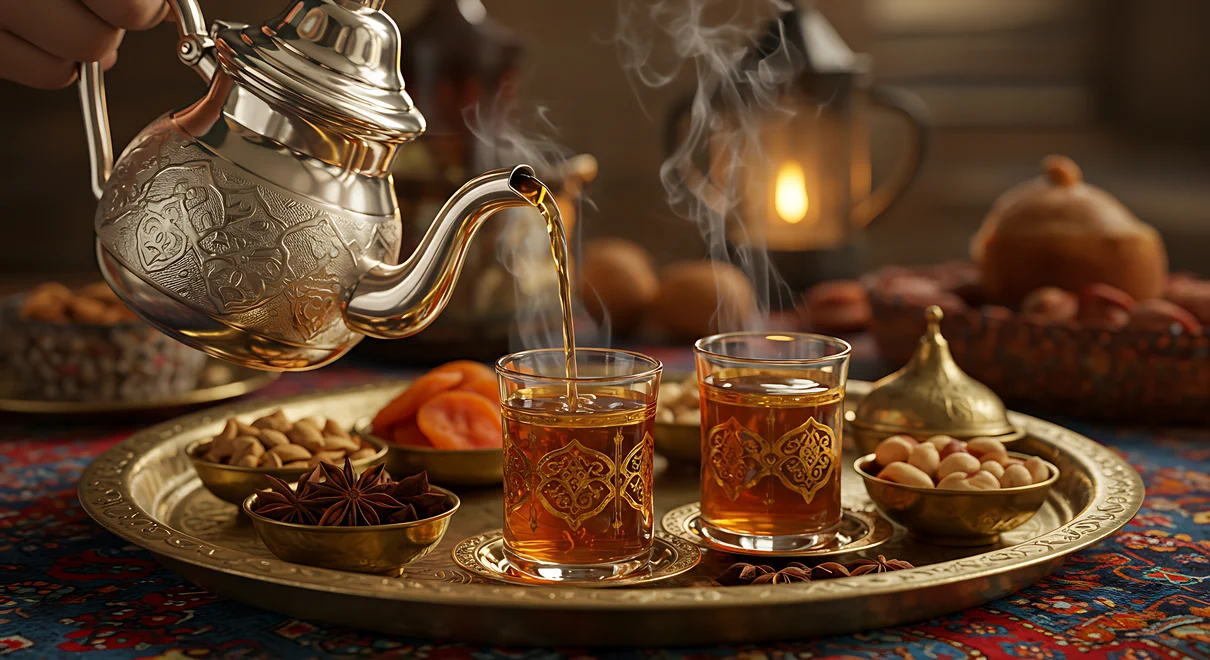
Once the tea is ready, it is served in rounds—typically three. Each pour, each round, follows a deliberate pace, creating a rhythm of presence and attention. The tea glasses are small, often decorated with gold filigree or bold colors, and always set on a polished tray.
The flow is cyclical, gentle, and thoughtful—one pot, multiple pours, many meanings.
Role of the Host: Pouring Tea as Status and Care
In Morocco, the host is both the conductor and the storyteller. Their pour speaks volumes. Holding the teapot aloft—sometimes as high as two feet—they let the tea cascade into each glass with a practiced elegance. The height of the pour is more than visual flair; it aerates the tea, creating a delicate froth known as the “crown,” a sign of proper preparation and respect.
A high, clean pour shows attentiveness and mastery. A low, lazy pour may be interpreted as rushed or inattentive. The host must remain engaged—eye contact soft, posture upright, movements precise.
Refilling empty glasses before they’re requested, adjusting sugar levels to suit the guests, or offering more mint on a hot day—these are the silent markers of a gracious host. They do not ask if you want more; they watch. They know. They pour.
In some homes, the patriarch or matriarch takes on the role of tea-maker. In others, it’s a shared or rotating duty. But regardless of who pours, the act itself is deeply tied to hospitality, hierarchy, and emotional attunement.
Symbolism of the Three Cups in Moroccan Tea
The first glass is for welcome,
the second for conversation,
the third for friendship—because tea is served until strangers feel like family.
These three rounds of tea are not mere refills—they are a symbolic journey. Each cup is brewed successively from the same leaves, drawing out different depths of flavor and meaning.
- The first cup: Light and fragrant, often sweetened generously. It sets the tone—welcoming, approachable, soft.
- The second cup: Richer, deeper, slightly less sweet. It is during this round that conversations deepen, laughter emerges, trust builds. It carries weight.
- The third cup: More austere—less sugar, more tannin, astringent. It signals the end of the visit, a gentle winding down. There is no rush to leave, but the ceremony’s arc is clear.
The repetition creates a ritual rhythm—one that mirrors the phases of encounter, connection, and closure. Guests who know the custom rarely leave before the third cup. To do so would be to break the unspoken story that the tea is telling.
Guest Etiquette: Posture, Acceptance, and Sipping Tea
Just as the host must pour with elegance, the guest must receive with grace. Body language is part of the ceremony. Guests often sit upright, slightly leaned in, signaling attentiveness. Crossing legs or slouching may be seen as too casual or disengaged, depending on the setting.
When tea is offered, one receives it with both hands or the right hand (culturally preferred), and always with a slight nod or smile. Taking a glass without acknowledgment may be interpreted as cold or indifferent.
Sipping is slow. The glass is small for a reason: this is not meant for thirst-quenching but for conversation-pacing. Sip, pause, speak. Sip, listen. In this ceremony, silence is welcome, even honored. Between sips, moments of shared quietness settle like warmth in the chest.
Children often learn this posture from watching their elders. The ceremonial discipline is not taught explicitly; it’s absorbed, mimicked, inherited. And in this way, the tradition persists—not rigid, but reverent.
Gracious Refusals: The Art of Polite Deferral
In Morocco, saying no to tea is an art form. To decline outright might seem abrupt, even rude. But to refuse with grace is entirely acceptable—and even expected at times. Hospitality here is insistent, but not imposing.
A polite refusal may come with a hand gesture over the glass, a gentle smile, and a phrase like Baraka Allah fik (May God bless you), or Safi, shukran (That’s enough, thank you). Tone matters. The refusal is rarely final—more a dance than a declaration.
Hosts will often offer multiple times, especially if they sense hesitation. A guest may say no once, then accept the second time. This is part of the script. It shows modesty and respect on both sides.
Understanding this dance is crucial for outsiders. Accepting too quickly may seem greedy; refusing too firmly may seem cold. But with a little cultural fluency, the balance becomes intuitive: offer, refuse, insist, accept.
Grace Is in the Details: Closing Reflection
To the untrained eye, the Moroccan tea ceremony may seem like a simple act—pouring tea, drinking, chatting. But for those who know how to watch, it is a masterclass in presence. The pour, the pause, the third glass, the shared silence—each is a thread in a tapestry woven not just with tradition, but with deep, attentive care.
Hospitality here is not loud. It is not rushed. It does not need to be declared. It is felt in the warmth of the glass, in the precision of the pour, in the way a host notices your empty cup before you do. It is in the gentle burn of fresh mint and the quiet bitterness of the last sip.
So the next time you are offered tea in a Moroccan home, do more than drink. Sit up. Slow down. Watch. Receive. Say yes, then no, then yes again. Let the ceremony hold you.
Because in this ritual, grace is not spoken—it is steeped.
Enjoyed this article?
Want more insights on wellness, fulfillment, and high-performance living? Subscribe to our newsletter for exclusive updates and resources.